
Samara National Research University participated in a bilateral special meeting with representatives of the Indian Space Research Organisation and Roscosmos during the period of the First Russian Space Forum, held in Moscow on 9th April 2026. The meeting was conducted in a dedicated bilateral format.
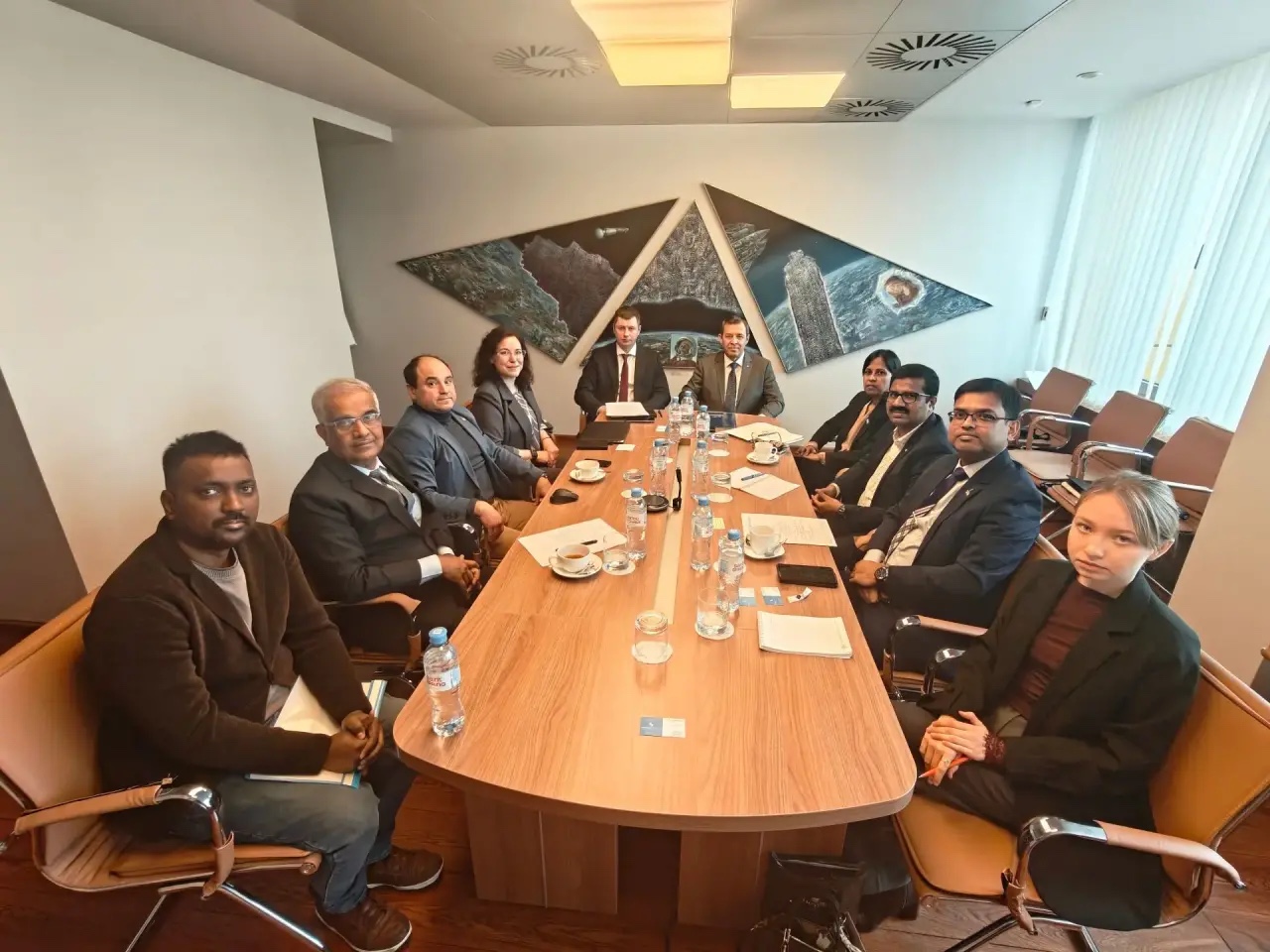
The discussion focused on strengthening India–Russia cooperation in advanced space technologies, including the possible joint development of cryocooler systems for future space, scientific, industrial and strategic applications.
Samara University was represented by its leadership and specialists in aerospace engineering and cryogenic technologies, including Anna I. Rozentsvaig, First Vice-Rector of Samara University; Professor Dmitry A. Uglanov, Head of the Laboratory of Cryogenics and Refrigeration and Professor at the Department of Heat Engineering and Thermal Engines; and Naresh Kedam, Assistant Lecturer at the Department of Heat Engineering and Thermal Engines.
Indian academic participation was led by Professor Milind Atrey, Deputy Director at the Indian Institute of Technology Bombay, and INOX Chair Professor of Cryogenics. Professor Atrey is a recognised expert in pulse tube cryocooler research and cryogenic engineering.
The meeting built upon the existing Memorandum of Understanding between Samara University and IIT Bombay, which supports academic and research cooperation, student and faculty exchanges, and joint scientific activities. Both institutions have already developed a strong foundation for collaboration through expert visits, workshops and ongoing academic engagement in cryogenics, refrigeration and space applications.
A key topic of discussion was a proposal to establish a long-term India–Russia partnership for the development and manufacturing of cryocooler technologies. The proposed initiative seeks to bring together Samara University’s aerospace engineering, manufacturing and testing capabilities and IIT Bombay’s scientific expertise in cryogenic system design, with institutional support from the Indian Space Research Organisation and Roscosmos.
The proposed cooperation may support the development of indigenous cryogenic technologies for satellites, space missions, scientific infrastructure and advanced industrial systems. Such technologies are increasingly important for future space missions, Earth observation, scientific payloads, propulsion-related systems and advanced thermal-control applications.
The participants also discussed the broader strategic context of future India–Russia space cooperation, including the development of new orbital infrastructure and the growing role of reliable cryogenic and thermal-control systems in next-generation space technologies.
The proposed collaboration is expected to contribute to:
● strengthening technological independence in critical space technologies;
● expanding joint research and engineering cooperation between India and Russia;
● supporting student, doctoral and postdoctoral exchange programmes;
● developing advanced cryogenic and thermal-control solutions for future missions;
● creating opportunities for long-term academic, industrial and commercial cooperation.
Samara University views this initiative as an important step in deepening scientific and technological cooperation with Indian partners. The combination of Samara University’s aerospace engineering and applied research capabilities with IIT Bombay’s cryogenic expertise provides a strong foundation for future joint projects.
The bilateral meeting confirmed mutual interest in expanding cooperation and moving from academic exchange toward applied research, technology development and future industrial implementation.
